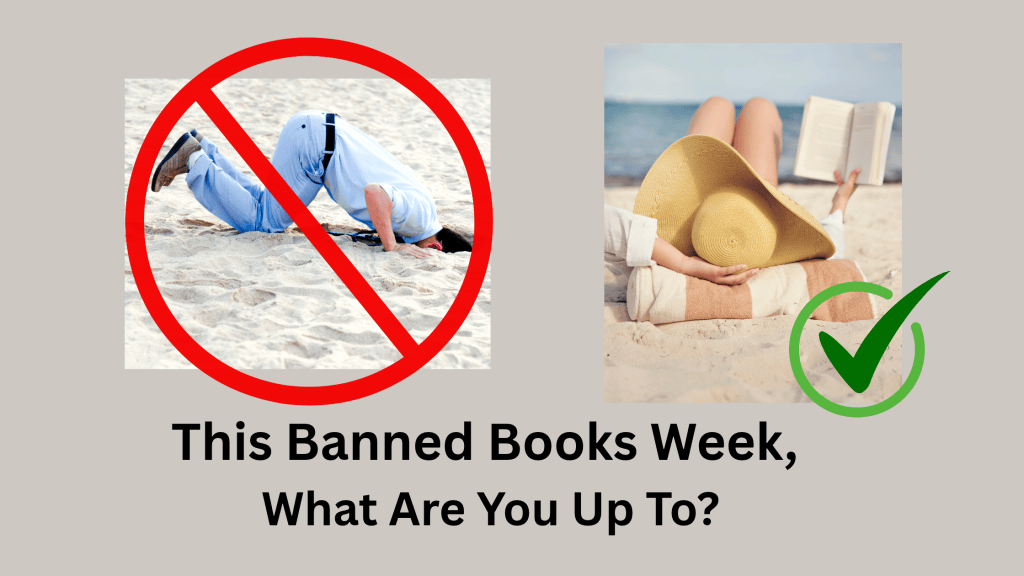
You’ve probably heard about them. They’ve been in the news… in your libraries… in your schools.
So, let’s talk about book bans and this annual week that puts a spotlight on censorship.
Let’s get a few, big picture, kinda universal things out of the way before we continue:
- You will not agree with everything I say
2. You will not agree with everything any hypothetical person says
3. I will not agree with everything you or any hypothetical person says
AND
4. I and every person should be allowed to investigate and make our own decision
Ignorance, as in being “unaware, uninformed,” or “destitute of knowledge or education” (as pulled from Merriam Webster’s definition of “ignorant”) does not help solve any issue.
I, personally, like to believe that a healthy relationship with ignorance or mystery or acknowledgement of what we do not know is an integral part of science as well as really everything about life as Stuart Firestein details in his 2012 book Ignorace: How It Drives Science
“And so it occurred to me that perhaps I should mention some of what we don’t know, what we still need to find out, what are still mysteries, what still needs to be done–so that these students can get out there and find out, solve mysteries and do these undone things. That is, I should teach them ignorance.”
–Stuart Firestein, 2012, Ignorance: How It Drives Science, pg 4
To me, the world is a beautiful place full of interesting things and people, many of which and whom are different from me in infinite ways with different experiences to the degree that I may never truly understand them.
But/ And I can try. And from that study, make decisions for myself.
These decisions may or may not agree with them or disagree with them or create an argument and belief system that is wholly my own built upon the foundations of many other people’s thoughts, opinions, treatises, data, etc.
The issue with censorship is it encourages the pejorative nature of ignorance. And honestly the fear that is associated with it. “This is ‘bad’ [in my opinion] and therefore we do not speak of it.”
As someone who works in informal education and writing, I hear the argument all the time that children, especially, need to be protected from certain topics and that you can’t explain it to them.
I disagree. Children are much smarter than we give them credit for. They are often exposed to more challenges and, unfortunately, the not nice side of humanity and the world already. Pretending these things don’t exist does not prepare them or protect them from these things. There are age-appropriate ways we can discuss ideas with them to protect them.
Okay, so there’s my rant on censorship and banning books.
The American Library Association has listed the following books as the most banned of 2025.
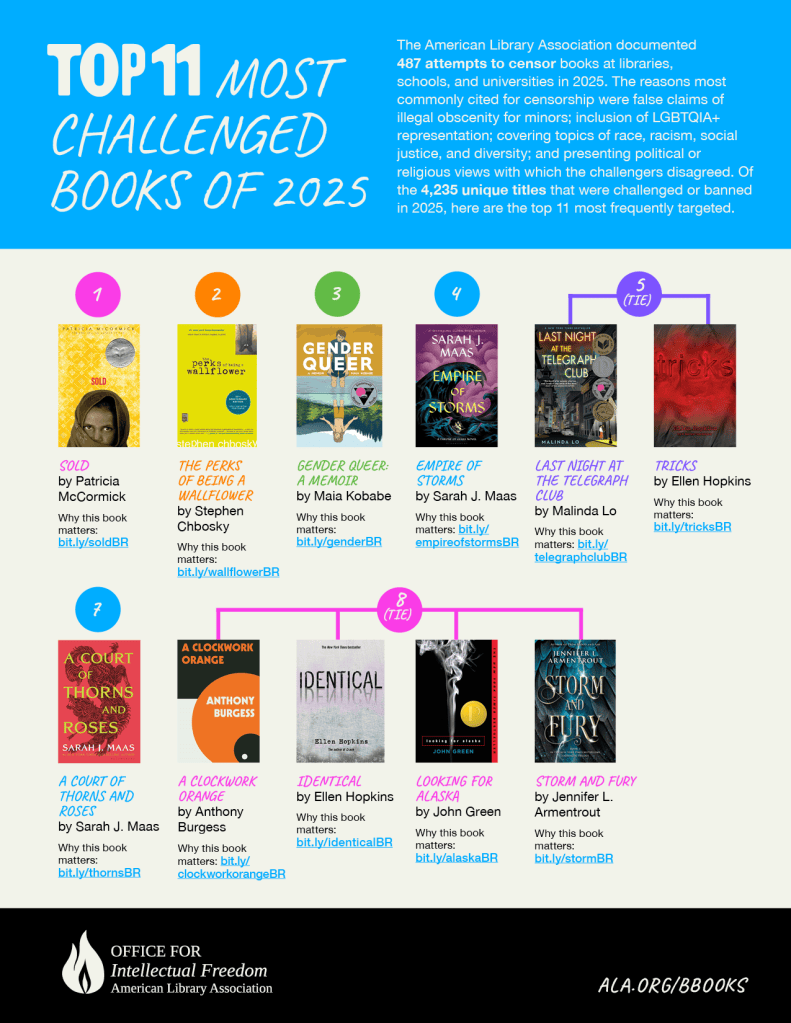
The links for all the books displayed above go into the specifics of the censorship arguments for each, but the Banned Books Week About Page sums them up on their as such
“The most common justifications for censorship provided by complainants were false claims of illegal obscenity for minors; inclusion of LGBTQIA+ characters or themes; and covering topics of race, racism, equity, and social justice.”
–Banned Books Week About Website, https://bannedbooksweek.org/about/
So, if you are as fired up about censorship, the banning of books, and more going on here, consider participating in Banned Books Week in some way.
- Purchase/ check out/ share a banned book
- Post on social media (again, they’ve got plenty of downloadable, shareable content on their Free Downloads page)
- Talk about it with someone
- Reach out to your political officials (especially local ones like school boards and town/ district/ ward/ municipality reps) to express your opinions
- Support your local library and let them know your thoughts (ideally, but not necessarily in official documentation like surveys and such)
- Attend one of the many Banned Book Week events happening at libraries, indie bookstores, and more.
- Banned Book Week has an official list here
- Libro.fm is hosting national read-ins
- Right-to-Read Nights
- Check around at your local libraries, indie bookstores and more if they aren’t officially attaching themselves to one of these lists
- More ideas here: https://bannedbooksweek.org/let-freedom-read-day/ especially regarding October 10th, Let Freedom Read Day
Technically, Banned Books Week started on the 4th and goes until the 10th, so even if you are a little late to the game (like me) it’s not over!
In the words of the ALA and Banned Books Week:
“Books are for everyone. Books should be read. Books should be uncensored. Let Books Be. Protect the Freedom to Read.“
—https://www.ala.org/bbooks/bannedbooksweek/ideasandresources/freedownloads
What are your thoughts on censorship and banning books? What are you doing this Banned Books Week?
Let’s learn together to help all of us rise together.
Until next time.


Leave a Reply