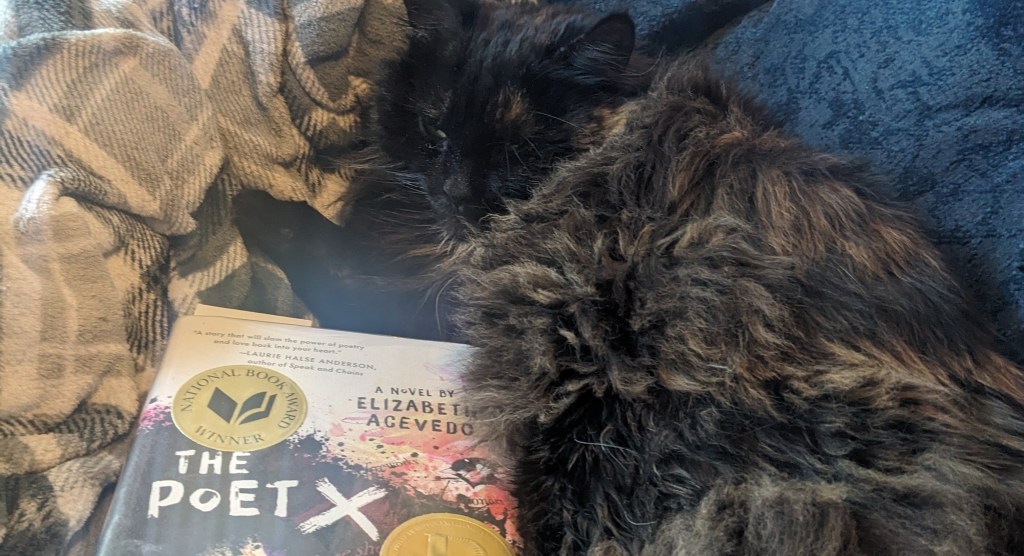
Despite the fact
I’ve been a writer as long as I could physically do so,
and a storyteller before that,
and my 8th grade yearbook (which came back into my life this week via my visiting parents ) literally predicted I’d be a poet,
I’ve never been particularly drawn to, enjoyed, “got” poetry.
I’m not sure if it was how it was taught, the examples/ required reading, or what, but it just wasn’t my thing.
And while, I still assert the fact that they predicted me as a poet mainly because I was such a wallflower most people didn’t know me, every once in a while, I’m reminded there is poetry out there that I am drawn to, do enjoy and “get”. And that even I can at least strive for being poetic in my writing.
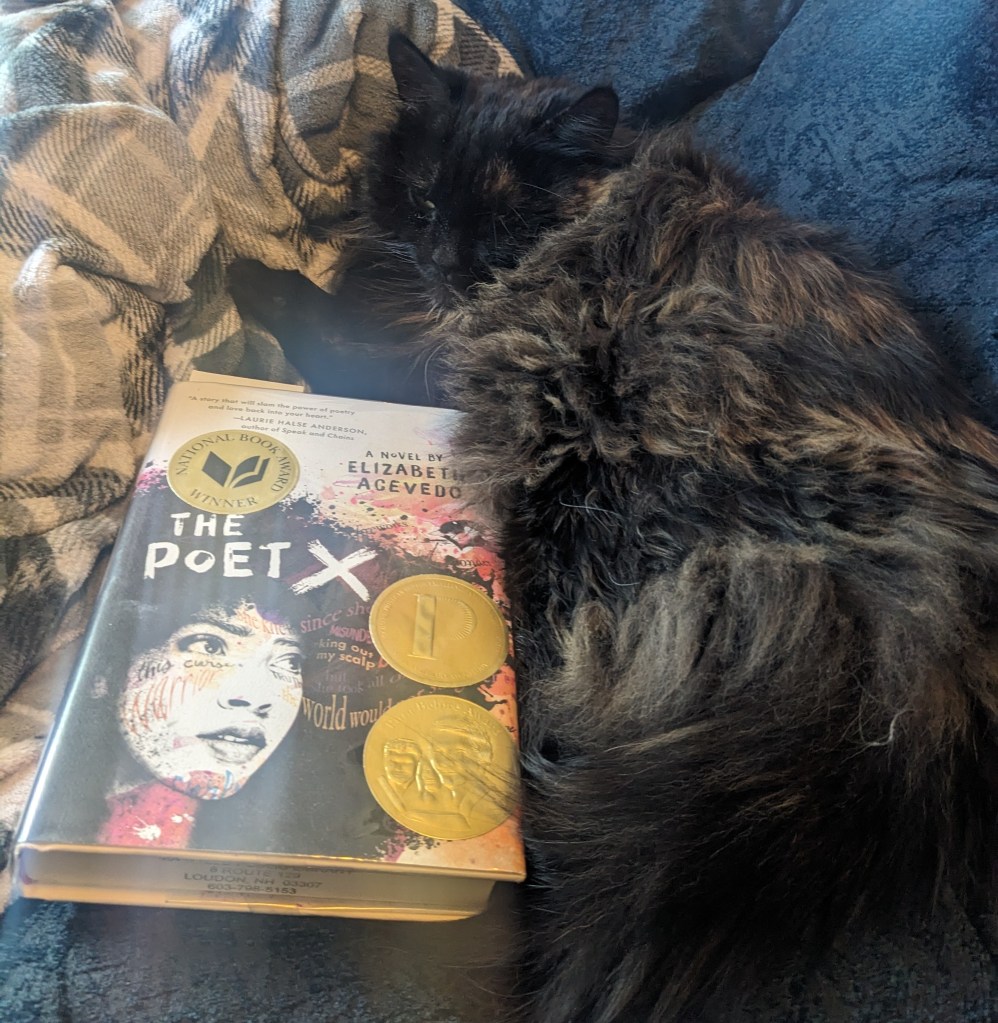
A book that has been on my radar, recommended to me multiple times, and even showed up in my life for free, finally made it into my hands for reading. This is actually extremely timely because, as unfortunately I expected in today’s day and age, it appeared in a Federal District Court case for being “anti-Christian” and therefore “violated their right to freedom of religion” as Wikipedia sums up.
So, I’m following up my Banned Books Week post with an unexpected reflection.
The Poet X by Elizabeth Acevedo is a novel-in-verse about a fifteen-year-old girl dealing with the fact she’s… a fifteen-year-old girl. Told through the main character’s poems and other writing, Xiomara tries to sort out the various contradicting realities of being a girl, and particularly a larger black girl in our society today. In addition to all of this, she’s struggling with the fact that Catholicism, which she has grown up in, no longer provides the solace it used to (partially based on some of the other things already referenced and for other reasons).
Despite the fact I’m white as a piece of paper and from an upper middle class background (when middle class actually meant fairly well-off), the story hit home.
I am also a “recovering Catholic”TM as it has become known and I was also raised female.
Xiomara’s story, while extremely different in a variety of layers, rings true as a clanging bell to me at times.
The difference?
I only went through many of these realizations much later in my life, not as a teenager.
Growing up, I was sheltered. Like seriously sheltered. I was the Catholic kid who actually did all the Catholic things. I believed it all. I didn’t know any other way. I walked the walk that was put in front of me. Looking through the yearbooks my parents brought up and then hearing Xiomara’s story this week retreads the journey I’ve been on for a couple years… a decade in some ways.
I grew up in the same purity culture. I remember being ushered into the Church, just the girls as the boys were off doing something else. A visiting woman from some other organization came in, stood on the altar’s steps, held up a piece of foil cut into the shape of a heart and told us that this was our purity. Our goodness. Everything beautiful about us. Everything good and vital. She then crumpled it into a ball, dropped it onto the floor, and stepped on it, grinding it into the marble (likely faux marble, gosh I hope it was faux) floor.
“This is what you are when you let your purity be taken from you, when you have sex before marriage,” she proclaimed as she held it back up for us to see, to marvel at and be disgusted at. “Who would want this?’ She exclaimed with a truly horrified and disgusting look.
And then we spent the next block of our schedule (so up to an hour and half) in which she explained all the ways we could cause our purity to be tarnished and destroyed, for sex wasn’t the only way. The mere idea of sex, of being trashy, of being too flirty would show the good Catholic boys that we were, in fact, nothing more than a balled up piece of foil that could never, as hard as we might try, be pulled back into a beautiful heart.
Now, I hope most of you reading this see the manipulative and honestly poor logic in this argument. I hope you poke holes in it, even laugh at it. I’m sure even some of my classmates in my Catholic middle school did.
I didn’t. I’d been raised since birth to believe every word uttered in Church was pure and absolute truth, nothing else. No questions could, should, had any right to be asked about what was said in this holy place, by messengers of truth and God’s Word. Their word, like that of my parents’ was absolute with no wiggle room.
It was the box in which I lived.
I look back at the pictures of myself in these yearbooks, how… trapped I look. The underlying pulse of unease and uncertainty. I think I’m happy. I’ve been told I should be happy. I’m blessed after all. Blessed to be born within a good Catholic, God-loving* (*read “fearing” instead) house as opposed to the sin-ridden filth of the rest of the world, the ignorant wretches who would turn to God if they only knew.
And it was my job to resist their temptations, and ideally convert as many as possible to the way. I knew the rules I was meant to live by to be good and holy. I knew my role. And yet, I never felt comfortable.
To be fair, I knew my real job, as a female, was to find a good Catholic boy, marry, and have children*. (*read, as I do now “give birth to future Catholics, names to fill the attendance books that I would also raise in God-loving*(see above) manners.)
You may notice there’s a bit of a gap in those steps between finding a good Catholic boy and marrying him. This gap was what plagued me as a good Catholic middle schooler. How does one convince a good Catholic boy to marry them? They are supposed to be out there, waiting for a good Catholic girl. They are supposed to be waiting on, or more likely stumbling along and off, the path of righteousness that I would, through my feminine and righteous charms, gently nudge them back to without being pushy or a nag and show them the light of Godful marriage.
Xiomara, in her own ways, struggles with many of these issues too. Where do girls fit in in Catholicism? How do teens deal with the rising emotions and hormones of puberty? What is right? What is wrong? Why does what feel so natural actually damn us? Why does a God who created us hate when we are ourselves?
I’m only about a hundred pages into the 350ish page book (as of typing this out, but who knows, I might be done by the time it posts!). These pages flew by in about 45 minutes partially due to it being poetry as opposed to prose and partially due to the natural ease of the language. And yet, the language is so impactful, I found myself reflecting on the words, the messages, the aching toll within my chest and grief for my past self who saw so many of the same things as Xiomara, but had a different reaction.
Where I
nodded,
internalized,
believed the messages being told to me,
scrunched myself down willingly,
believed that I was, with no room for question or wiggle room, a girl and all the rules and expectations they dictated went with that (how could I think there was any other option? The option for another option didn’t exist)
believed I was both the fault and the salvation of others
believed I, and the rest of humanity, was always on the precipice of evil, and only this version of God and His Rules was what was barely keeping me on the side of good.
Where I did that…
Xiomara
questions
and fights back
in whispered morality discussions veiled as gossiping about boys,
refuses to take Communion (oh my, I felt the stares and judgment of her family as she alone sat in the pew as they all filed past and then is ordered to never do that again even though the pastor says Communion should only be taken in joyful acceptance)
uses poetry to document, wrestle, and heal.
This Banned Books Week, I’m reflecting on the fact that I grew up in a house of censorship.
In so many more ways than I could explain in this blog post, maybe even in a book. For I wonder if I will ever stop realizing the little ways in which I was sheltered from the world in fear. The little things I thought were normal and yet weren’t.
The argument for censorship, especially for children is to protect them. If they never know, they will never do it.
Despite the fact, most of us know about the sheltered religious kid who got a taste of freedom and ended up in a spiral. They teach us the horror stories eventually. Again, the fear is more important. As Xiomara expresses it so well:
“What if I like a boy too much and become addicted to sex
like Iliana from Amsterdam Ave.?
Three kids, no daddy around,
and baby bibs instead of a diploma hanging on her wall.”
—The Poet X, 2018, “Questions I Have”, pg 32
Many of my fear-induced warnings also included drugs, alcohol, depravity of various measures.
But Xiomara continues this thought, pushing beyond just this immediate fear to ones that I also harbored in unknown, unspoken, unrealized ways (without the curses) until decades later when I understood I was allowed to question.
“What if I like a boy too much and he breaks my heart,
and I wind up angry and bitter like Mami,
walking around always exclaiming how men ain’t shit,
even when my father and brother are in the same room?
What if I like a boy too much
and none of those things happen…
they’re the only scales I have.
How does a girl like me figure out the weight
of what it means to love a boy?”
—The Poet X, 2018, “Questions I Have”, pg 32-33
And this is the thing that gets me about all of this censorship, this fear-induced obsession with creating a bubble around kids that you determine what comes in or out of.
Truth should be able to stand up to questions.
The world is not made up of black and white, good and bad, easy decisions.
Very little in this life is simple.
Every other person you meet will think and view the world differently than you because they experienced the world differently than you.
Delving into this questions, these various viewpoints, helps us see the reality and beauty of the world and those around us.
Sometimes it also shows ugliness, fear, and horrors. These things also exist in the world. Knowledge helps us make up our own minds about complicated situations. It helps us prepare ourselves and protect ourselves.
Ignorance creates a false utopian bubble in which we hide our heads in the sand and actually open ourselves up to being manipulated, hurt, and worse by those who would choose to harm. And inflicting harm on ourselves.
That’s it for today.
I think I’ve ranted
and rambled
and bared my soul and
shared my trauma enough.
For today.
Much of this was realized and worked through in the writing of my first manuscript, which is part of the reason it still hasn’t been fully realized and published. Healing is messy. I’m currently cleaning it up to actually be helpful to others in a complete, engaging adventure.
Thank you for dealing with my poor attempts at poetry at times in this post. I’m trying it out. Art in all forms can be extremely helpful in healing and figuring out the shit whirling inside of us. Even when we’re inept and messy at it.
What are your thoughts on this book? Others? Your writing and healing journey?


Leave a Reply